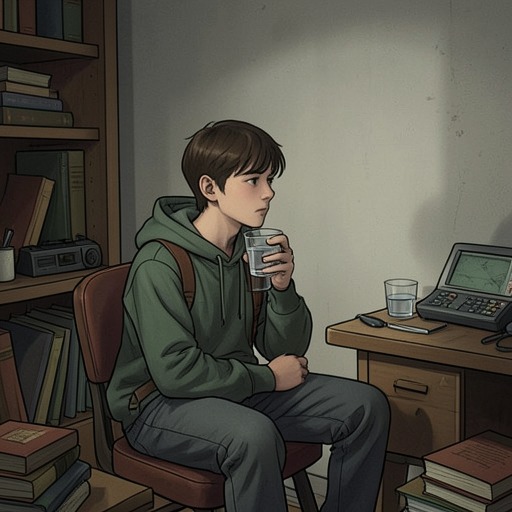
Susan discovers the bite mark on Bret’s arm
The ShardsSix days after the attack on Canon Drive, Bret Ellis visits Susan Reynolds in her bedroom and finds her recovering from severe injuries. When she spots a wound on his forearm and believes it is the bite mark she left on her attacker, the quiet visit becomes a crisis of recognition: Susan suspects Bret may have been the assailant, and he responds by physically restraining her and demanding that she keep his secret. Her later report to Thom Wright, followed decades afterward by Thom’s question to Bret, carries the suspicion beyond the bedroom without resolving it for the reader.
The Visit During Susan’s Recovery
Bret arrives at Susan’s house on a Friday afternoon, six days after the attack. Gayle lets him in and leads him upstairs to Susan’s bedroom. Susan is propped up in bed, sedated by painkillers and listening to Icehouse. The bandage around her chest makes the damage unmistakable: one side of her body is flattened, and the injury is too stark for Bret to meet without suppressing a gasp.
Their attempt to hug turns into a painful, tearful embrace. Susan’s bandaged hand covers her mouth as she cries; Bret bows his head and sobs. Neither needs to spell out what the tears include: the attack, what happened to Thom, what happened to Robert, the song in the room, and the larger accumulation of their recent losses. Their reunion is at once intimate and deeply fragile, a moment of shared grief before the discovery that changes its terms.
They speak quietly and make promises. Susan tells Bret that she saw Thom on Wednesday, before she was discharged, and that Thom would be all right. Bret has barely left his room, has not returned to Buckley, and says he is taking Vicodin continually. The details establish how narrowly both friends are moving through recovery: Susan is confined to bed, while Bret has come to see her despite his own isolation and medication.
The Wound and Susan’s Recognition
Susan asks Bret what happened on Saturday night in Robert Mallory’s apartment and asks him to tell her what really happened. Rather than answer, Bret places a finger to her lips. She smiles in recognition and closes her eyes; the gesture belongs to a familiar exchange between them, one that signals they need not say what they already understand, or what would make no difference if spoken. That shared shorthand briefly appears to protect the tenderness of the visit.
The mood shifts when Susan notices Bret’s exposed forearm. He is wearing a long-sleeved blue Polo shirt, but the sleeve falls back as he lifts his arm. She sees a deep wound surrounded by purple-and-yellow bruising, and her relaxed expression disappears. She reaches for the sleeve and draws it farther down to inspect the injury. The narrative marks the turn as a sudden activation: the earlier exhaustion and ease give way to tension, while Susan shakes and looks from the wound to Bret.
Susan says she thinks it is a bite mark. She believes it lies precisely where she bit the intruder on Saturday night and that the indentations of her teeth are visible. The wound therefore becomes more than an injury: to Susan, it is a bodily trace connecting Bret to the person who attacked her. Her recognition is immediate, but the scene does not independently establish who caused the wound. That gap between what Susan believes she sees and what Bret says becomes central to the event’s unresolved force.
Secrecy, Force, and the Collapse of the Visit
Susan stares at Bret without speaking, then starts to cry and vomits onto the front of her robe. When he asks what is wrong, she pulls away while he clutches her bandaged hand. She turns aside, trembling and shaking her head, with drool and vomit on her chin. The scene’s physical details register the shock of her suspicion before she can make a fuller accusation.
Bret tells her not to worry, says Robert is gone and cannot hurt her anymore, and grips her hand so tightly that she cannot pull away. He asks whether his secret is safe with her, repeating the question in a whisper. As he reassures her that she is safe, he continues crushing her hand until he feels it begin to break. Susan faints and slides off the bed. The language of comfort and the violence of his grip operate together: Bret presents his words as reassurance while making it physically difficult for Susan to escape or answer.
Bret then manages the appearance of an ordinary medical emergency. He leaves the room and tells Gayle that Susan feels strange, took too many painkillers, vomited, passed out, and may have broken something in her hand. Gayle rushes upstairs and calls a doctor; Bret helps move Susan to another room after the bed is found wet with urine. His account redirects attention toward medication and the fall, while his earlier demand and the injury to Susan’s hand remain concealed from the explanation he gives Gayle.
The Suspicion’s Afterlife
Bret assumes Susan never told anyone what she thought she saw and says he never spoke to her again. Susan does not return to Buckley; she finishes her senior year at Marymount and graduates in June. The bedroom encounter thus becomes their last meeting for decades, leaving Bret’s assumption of silence in place until a later conversation reveals that it was mistaken.
When Bret and Thom meet again years later, Thom tells him that Susan called from the hospital after seeing him. She sounded high and desperate, and told Thom she had seen something on Bret’s arm. She wanted them to call the police because she thought Bret had done it. Thom initially dismissed her as crazy and said he would deny the accusation, but admits that her certainty frightened him. At their reunion, he finally asks Bret whether it was him. Bret says it was not, attributing Susan’s belief to her being high on painkillers when she saw the wound. The later exchange confirms that Susan did disclose her suspicion, but it does not provide independent proof that either her interpretation or Bret’s denial is true.
The episode makes the body both evidence and an unstable surface of interpretation. Susan reads the wound through the bite she remembers inflicting; Bret responds by suppressing speech and controlling her body, then offers a benign account of her collapse to Gayle. The scene’s uncertainty is not resolved by the later conversation: instead, Susan’s report and Bret’s denial remain in tension, showing how an experience can be hidden from public view yet return through memory, testimony, and questions delayed for years.